

Easy Junk Journal Ideas for a Slow, Cosy Evening
Some evenings you want to make something, but you don’t have the energy for a big project. You have a cup of tea, half an hour and a small pile of paper on the table. That’s enough for a junk journal page, as long as the idea is simple.
This guide collects easy junk journal ideas for exactly those evenings. Each one takes ten to thirty minutes, uses things you probably already have, and doesn’t need a plan or any drawing skill. You’ll also find a simple routine for a slow evening, a table to pick an idea by the time you have, the small mistakes that make easy pages look messy, and answers to the questions beginners ask most.
Quick answer: the easiest junk journal ideas are a single background paper with one picture and a word on top, a tea or receipt page from your day, a pocket with a tag, a page of torn paper strips, a list page (“things I liked this week”), and a “collect the colour” page where everything is one shade. Pick one paper, one focal picture and one small extra, glue them down and stop there.
What makes a junk journal idea easy?
An easy idea isn’t a lazy one. It’s an idea with the decisions already made, so you can sit down and start gluing. The pages that feel hard are usually the ones where you open the journal, look at a blank spread and try to choose from everything you own at once.
Easy ideas have three things in common:
- They start from one thing. A paper, a ticket, a photo or a word. Everything else is chosen to go with it.
- They use few layers. Three to five pieces on a page is plenty. More layers need more planning and more drying time.
- They allow a “good enough” finish. A junk journal is meant to look collected and a little imperfect. Crooked edges and torn paper belong to the style.
If you’re brand new and still choosing a journal, start with how to start a junk journal, then come back here for page ideas.

A small kit for slow evenings
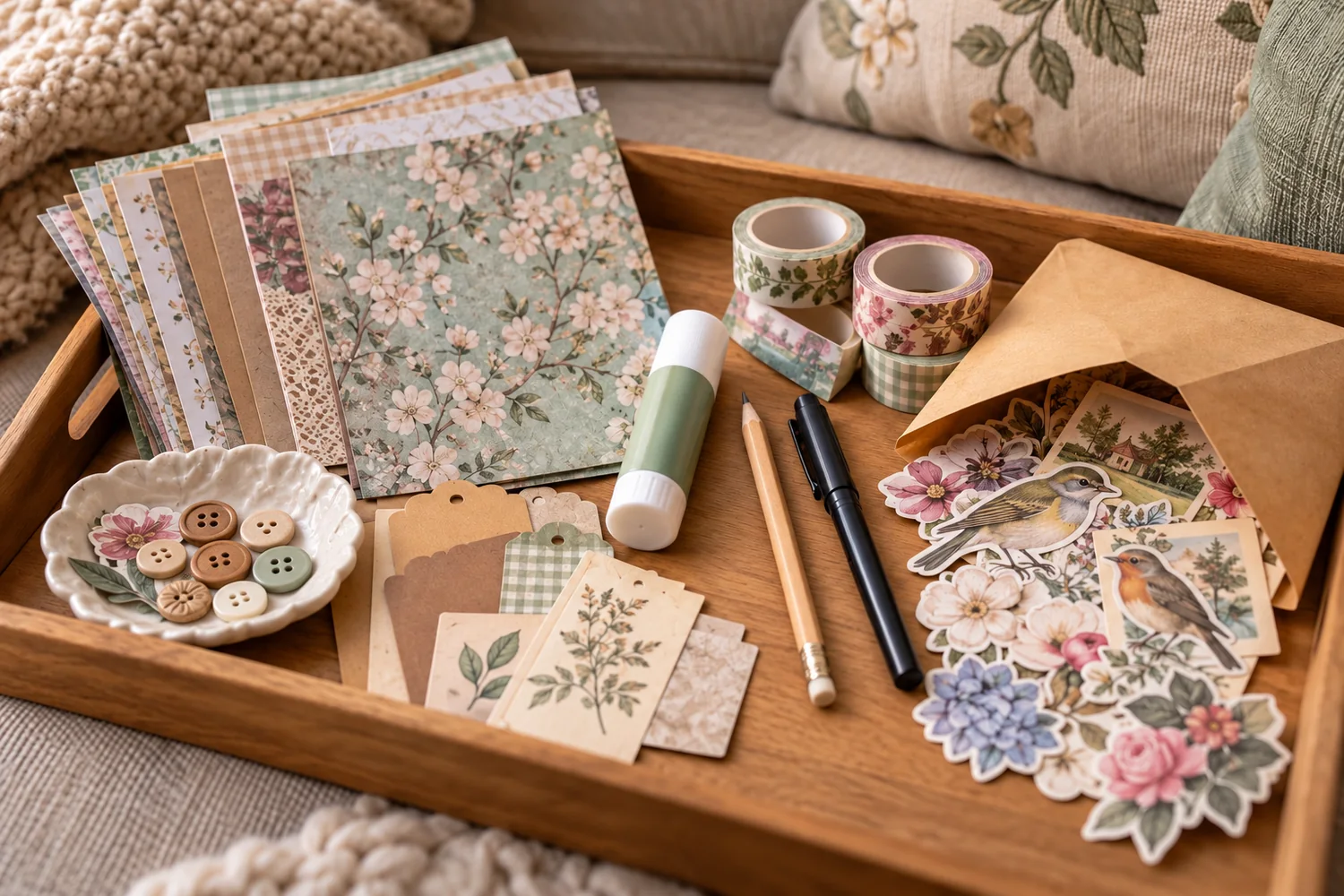
The fastest way to make journaling feel easy is to stop hunting for things. Keep a small box or tray that holds only what you need for a quick page, so you can open it on the sofa without clearing the whole table.
- A glue stick and a roll of double-sided tape.
- Small scissors.
- One pen you like, ideally a fine black pigment pen.
- Two or three rolls of washi tape in calm colours.
- A handful of printed background papers, cut to your page size.
- An envelope of cut-out pictures, labels and stickers ready to use.
- A few tags, paper clips and a small piece of lace or string.
The envelope of ready cut-outs saves the most time. When you print a sheet of ephemera or stickers, cut out a few pieces at once and keep them loose. On a tired evening you skip the cutting and go straight to the fun part. Our vintage stickers and fussy cuts and flower stickers are made for this. For the full list of tools, see junk journal supplies.
Ten-minute ideas
These pages are almost impossible to get wrong. Each one needs a single background and two or three small pieces.
- One picture, one word. Glue a background paper, add one large picture in the middle and write a single word under it: “rest”, “June”, “home”. Done.
- The washi tape frame. Tape a photo or postcard onto the page with four strips of washi tape at the corners, like it’s pinned to a board.
- Three stickers in a row. Line up three small stickers across the bottom third of a page and write the date above them.
- A torn paper strip page. Tear four or five strips from different papers and glue them across the page like stripes. Torn edges hide every wobble.
- The receipt page. Glue today’s coffee or shop receipt at an angle, add a small sticker and one line about the day.
- A colour swatch page. Cut small squares from papers in one colour family and glue them in a grid, like paint chips.

One-paper pages
When you have a paper you love, let it do the work. A busy floral, an old map or a piece of toile already looks like a finished page. You only need to add a quiet place for the eye to rest.
- Cover the page with the patterned paper, then glue a smaller plain card or tag in one corner for a few words.
- Cut a window. Glue a plain paper on top of the patterned one and cut a rectangle out of the plain layer, so the pattern shows through like a picture in a frame.
- Fold the bottom edge of the paper up by two inches before gluing it in. You get a pocket and a page in one step.
- Use one paper on both pages of a spread, cut so the pattern continues across the middle. It makes even a simple spread look planned.
Background papers printed at home work well here. Matte paper around 120 gsm (32 lb) is thick enough not to wrinkle under a glue stick. You’ll find ready sets in junk journal background pages, vintage backgrounds and gingham papers.


A small kit for slow evenings
If everything waits in one tin, an evening of journaling starts in a minute instead of half an hour of searching.
- Three or four patterned papers cut to the size of your journal.
- A handful of tags, labels and a few stickers.
- A glue stick, small scissors and one roll of washi tape.
- Refill it once a month with whatever you collected.
Pick a few coordinated backgrounds for your tin, then add plain tags and saved scraps. Browse journal paper and kit previews with links to the sets, so the small kit feels easy to use.
Pockets, tags and tuck spots
Pockets look clever, but they’re one of the easiest things you can add. A pocket also gives you somewhere to put the small bits you can’t decide about, which keeps the page itself calm.
- The envelope pocket. Glue a small envelope flat on the page with the flap open. Tuck in a tag or a folded note.
- Half-page pocket. Glue a piece of card along three sides on the lower half of the page. The open top edge is the pocket.
- The paper bag pocket. Flatten a small paper bag, trim it and glue it in. The bottom fold makes a second slot.
- Tags on a clip. Clip two or three tags to the edge of the page with a paper clip, so they stick out of the closed journal.
- Belly band. Wrap a strip of paper around a single page and glue the ends at the back. Slide a photo or card under it.
If you’d like your envelopes and pockets to come out the exact size of your journal, our free Template Maker draws the outline for you to print on the back of any paper. More pocket styles are in junk journal pockets.

Easy writing ideas
Many people stop journaling because they think they need to write something meaningful. You don’t. A few words are enough, and a list is often better than a paragraph.
- “Three good things today.” Write three small things on a tag: a warm bath, a funny message, the first frost.
- A weekly list: books you read, songs on repeat, meals you liked.
- One overheard sentence. Write down something you heard on the bus or at work, in quotation marks.
- Your weather and mood in five words, written along the edge of the page.
- A letter you won’t send, folded small and tucked into a pocket.
- A quote from the book you’re reading, written on a strip of paper and glued under a picture.
If your handwriting bothers you, write on a tag or a scrap and glue it in. If it goes wrong, you make a new tag, not a new page. You can also cut words from magazines or old book pages instead of writing at all.


A page you can finish tonight
This is the kind of page you can really finish after dinner: small, warm and much easier than it looks.
- Ten minutes: one background, one picture, a date.
- Twenty minutes: add a folded pocket and a tag.
- An evening: a two-page spread with a photo and a note.
Start with what is already on the table.
Ideas from things at home
The “junk” in junk journal is the point. Your home is full of free, interesting paper that most people throw away. Keep a box near the door for anything flat and pretty.
| What you have | Easy page idea |
|---|---|
| Tea bag tags and wrappers | A “tea of the week” page with the wrappers in a row and a line about each flavour |
| Tickets and receipts | A day out page: ticket, receipt and one photo, held with washi tape |
| Seed packets | A garden page with the packet as a pocket and a sowing date on a tag |
| Food labels and tins | A kitchen page with the prettiest labels and the recipe you made |
| Old envelopes with stamps | Cut out the stamps and postmarks and glue them in a cluster |
| Book pages and maps | A background for any page; tear the edges for a softer look |
| Gift wrap and tissue | Background strips, or a translucent layer over a busy print |
| Coffee filters and baking paper | Soft, slightly see-through layers that make a picture look dreamy |
Want things to look older? A quick tea wash turns plain paper golden in ten minutes. We explain how in tea stained paper, and there are more ideas for found paper in ephemera ideas.

Easy seasonal pages
A season gives you a ready theme, a ready palette and a reason to make a page. These ideas take twenty minutes or less.
- Spring: a pressed flower or petal under a strip of tape, a pastel paper and the date of the first warm day.
- Summer: a holiday ticket, a postcard and one photo, or a “summer list” of places you want to go.
- Autumn: a leaf traced or pressed onto kraft paper, a gingham strip and a small note about the weather.
- Winter and Christmas: a red or green paper, one vintage Christmas picture and a tag with your favourite moment of the day. Our Christmas junk journal printables have papers, tags and pictures in one place.
For bigger seasonal layouts, see Christmas scrapbook ideas and garden scrapbook page ideas.


A whole page from one sheet
One printed paper is enough for a full page, and it always matches itself.
- Use half of the sheet as the background of the page.
- Cut a frame and a tag from the other half.
- Fussy-cut a few motifs, birds, flowers or houses, and use them as stickers.
- Add one plain element, such as a strip of lace or a cream label, so the pattern has room to breathe.
Choose a blue patterned paper with details you can cut into a tag, frame or small accent. Compare the paper previews and follow the links to the sets that suit your page.
Easy themes for a whole journal
A theme is the easiest plan of all. Once you know what the journal is about, every page idea chooses itself, and you can pick up the journal for ten minutes without wondering where to begin.
- A tea journal. One page per tea you try: the wrapper, a little colour swatch of the brewed tea on paper and a note on how it tasted.
- A book journal. One spread per book: the title on a tag, a favourite line, a picture that matches the mood and a star rating.
- A garden journal. Seed packets, pressed leaves, sowing dates and what grew. Botanical prints and flower stickers fill the gaps.
- A “small joys” journal. One small good thing per page, written on a tag and decorated with whatever is on the table.
- A recipe journal. Recipes you actually cook, with food labels, a gingham strip and notes on what you changed.
- A colour journal. Each page is one colour: everything on it, from paper to stickers to tape, is the same shade.
- A year in tickets. Every ticket, receipt and leaflet from days out goes in, in order, with the date on each page.
Themed journals also stay thinner and tidier, because you only add what belongs. If one theme feels too narrow, keep two small journals instead of one big one.

Easy ideas without a printer
A printer makes things quicker, but it isn’t required. Some of the loveliest pages use nothing printed at all.
- Tear and layer. Tear pages from an old book, a magazine or a catalogue into strips and glue them in overlapping layers.
- Trace and colour. Lay thin paper over a picture you like, trace the outline in pen and colour it in with pencils.
- Stamp a pattern. A single rubber stamp and an ink pad, repeated across a plain page, gives you your own patterned paper.
- Use fabric. A scrap of cotton, ribbon or lace glued with craft glue adds texture no print can.
- Draw simple shapes. Rows of dots, stripes or little hearts with a coloured pen look charming and take five minutes.
When you do get to a printer, at a library or a copy shop, print several sheets at once and cut them up for your small kit.
Easy junk journal ideas to make with someone
Junk journaling is a quiet hobby, but it’s also a lovely thing to do with a friend, a partner or a child. Easy ideas work best here, because nobody wants to wait while one person cuts for an hour.
- Swap a page. Each person makes one page, then swaps it. You end up with a page in your journal you’d never have made yourself.
- One theme, two journals. Choose a word, such as “autumn” or “home”, and both make a page about it at the same table.
- A letter page. Write a short note to each other on a tag, tuck it in a pocket, and only read it later.
- With children: give them a background paper, a pile of stickers and a glue stick, and let them fill one page of your journal. Our funny animal clipart is a hit with small hands.
Keep a few extra glue sticks and pairs of scissors in the box so nobody has to share at the busy moment.
Junk from your kitchen drawer
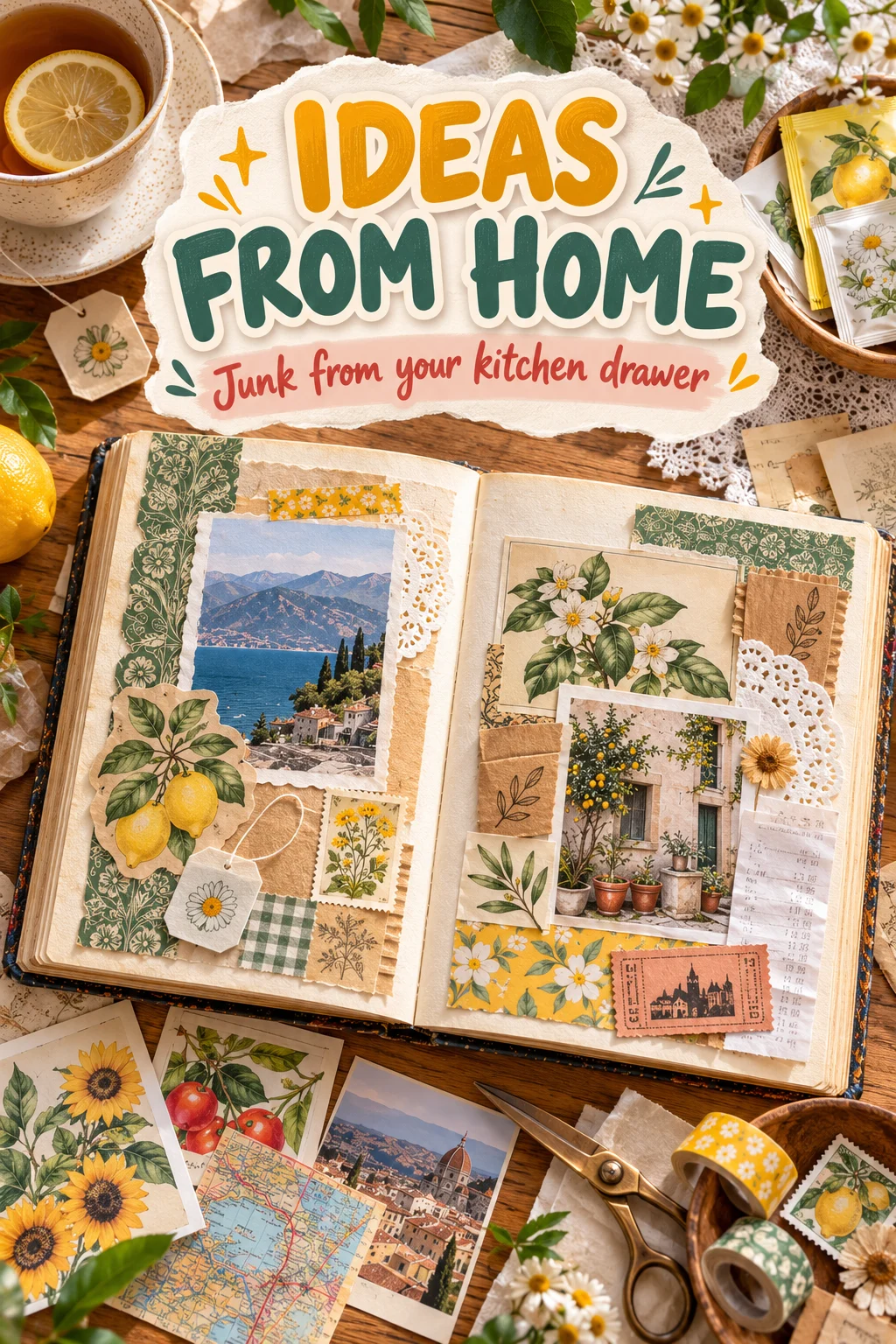
You do not need to buy ephemera. The kitchen is full of it.
- Dried, emptied tea bags: the thin paper is lovely as a background layer.
- Labels from jars, tea boxes and fruit, soaked off and dried flat.
- Old recipe cards, receipts and paper napkins with a pretty print.
- Press everything under a heavy book overnight before you glue it.
Mix a saved recipe or label with a printable aged background for contrast. Our vintage background collection shows paper previews and links to the sets when you want an aged layer without staining another sheet.
Pick an idea by the time you have
When you can’t decide, decide by the clock instead.
| Time you have | Try this | You need |
|---|---|---|
| 10 minutes | One picture, one word; three stickers in a row | one background, one picture or three stickers, a pen |
| 15 minutes | Torn paper strips; receipt page; washi tape frame | three to five papers, glue stick, tape |
| 20 minutes | Envelope pocket with a tag; “three good things” page | an envelope, a tag, a pen, one picture |
| 30 minutes | One-paper window page; seasonal page; tea of the week | a patterned paper, plain card, scissors or craft knife |
| A whole evening | A full spread across two pages with a pocket and tags | your small kit plus a few new printables |
A slow-evening routine
This is the order we use when we want to make a page without thinking too hard. It works with any of the ideas above.
- Choose one starting piece. A paper, a photo or a ticket. Put it in the middle of the table.
- Pull three things that go with it. Match by colour or by mood, and put the rest of the box away so it doesn’t distract you.
- Lay everything out without glue. Move pieces around for a minute or two. Take a phone photo if you like it.
- Glue from the back layer forward. Background first, then the main picture, then the small extras.
- Add one small finishing touch. A sticker, a strip of tape or a date. Then stop, even if you feel like adding more.
- Close the journal under a heavy book for ten minutes so the pages dry flat.
Stopping at step five matters more than it sounds. Most pages that look crowded were finished three pieces earlier.
Still stuck for a starting point? Our free Junk Journal Idea Generator gives you a theme, a layout and a list of pieces with one click. When you’re ready for more ambitious pages, there are fifty-three more in junk journal ideas for pages, pockets and prompts.

Small mistakes and easy fixes
| What happens | Why | Easy fix |
|---|---|---|
| The page looks busy and messy | too many patterns and pieces fighting each other | keep one patterned paper per page and add a plain layer for the eye to rest |
| The paper wrinkles | too much wet glue on thin paper | use a glue stick on thin paper, keep liquid glue for lace and buttons |
| Edges lift after a day | glue missed the corners | run the glue stick right to the edges and press under a book |
| The journal won’t close | too many thick layers on one page | spread pockets and tags across several pages and remove a few spare pages from the spine |
| Nothing seems to match | pieces chosen from different palettes | pick three colours before you start, or work in one colour family |
| You don’t like the finished page | it happens to everyone | glue a new paper over half of it, or tuck a big tag on top; a junk journal is always layered |
If you’d like to test colours before you glue anything, the free Color Planner lets you try a few palettes on screen first.
Common questions
What do you put in a junk journal for beginners?
Start with a background paper, one picture, a tag or small envelope and a few words. Add ephemera you’ve saved, like tickets, receipts and labels, and a few printable stickers. That’s enough for a full, good-looking page.
How do I make a junk journal page quickly?
Choose one starting piece, add three things that match it, glue them from the back layer forward and finish with one small touch, such as a sticker or a date. Keep a box of pre-cut pictures so you don’t need to cut anything on the night.
What can I use in a junk journal instead of buying supplies?
Tea bag wrappers, receipts, seed packets, old envelopes, book pages, maps, gift wrap, coffee filters and food labels all work. Printable papers and stickers fill the gaps for very little cost.
How many things should go on one page?
Three to five pieces is a comfortable number for an easy page: a background, a main picture and one to three small extras. Fewer pieces look calmer and dry faster.
Do I need to write in a junk journal?
No. Many journals are almost all pictures and paper. If you’d like a few words, a date, a list or a single word is plenty, and you can write on a tag instead of the page itself.
What paper is best for printing junk journal pages?
Matte paper around 120-160 gsm (32-43 lb) for backgrounds, ordinary printer paper for small cut-outs, and cardstock around 200-250 gsm (70-90 lb) for tags and pockets.
How do I keep my junk journal from getting too thick?
Spread bulky pieces across different pages, use thin paper for most layers, and remove one or two blank pages from the spine for every few pockets you add.
Make one easy page tonight
Pick one paper, one picture and one word. Give yourself twenty minutes and stop when the time is up. The page doesn’t need to be your best; it only needs to exist. Once there are a few pages in the journal, it starts to feel like yours, and the next ones get easier.
If you need papers and pictures to start with, browse the paper and backgrounds collection, the vintage stickers and the clipart sets.


